You Can’t Buy into the World’s Top Robotics Companies Now. From a Solana wallet, you can own a slice.
RoboStrategy (BOT) packs private robotics equity into a Nasdaq stock, and Backpack put a backed version on Solana. You can buy it, sell it, LP it, and likely one day soon borrow against it.

Figures as of July 20, 2026. They expire fast. Check before you act.
Market snapshot
BOT at a glance
- NAV / share
- $10.51
- Latest unaudited NAV · Jun 30
- Share price
- $27.32
- Nasdaq last sale · Jul 20, 11:40 AM ET
- Premium to NAV
- +160%
- Share price is 2.60× NAV
- All-time low
- $19.20
- May 13 · third trading session
The most valuable robotics companies on earth are all private, and all American. Figure AI, valued at $39 billion, builds the humanoid robots now working BMW’s line in South Carolina. Apptronik, at a reported $5 billion, has its Apollo robot in warehouse pilots with Mercedes-Benz and GXO Logistics, the contract-warehousing company that reported $13.2 billion in revenue for 2025. Standard Bots, at $1 billion, makes factory arms in New York. Dyna and Dexmate, both in California, are smaller and newer. And you cannot buy a share of any of them. They are private, and their stock is open only to accredited investors, a wealth-and-income bar most people never clear.
The robot in the second photo is not a render. In March 2026, Figure’s founder Brett Adcock brought one onto the Shawn Ryan Show and ran it live in the studio. If you want a feel for how far these machines have come, start there.
You can now hold a slice of all of them from a Solana wallet.
RoboStrategy is a Nasdaq-listed fund, ticker BOT, that holds shares in exactly these private robotics companies, with a handful of names making up most of it. It went public on Nasdaq on May 11, 2026. Since early July you can also hold a tokenized version of it on Solana, issued by Backpack Securities and made tradable by Sunrise. It trades around the clock and tracks the real stock.
What we'll cover:
- what the fund holds
- why you’d buy over NAV
- the pros and cons
- how the Solana version works
#What RoboStrategy actually holds
RoboStrategy, Inc. is a closed-end fund registered under the Investment Company Act of 1940. It is not a crypto protocol and it does not issue its own token. It is a Maryland corporation, advised by FP Strategies LLC of San Juan, and it listed on the Nasdaq Global Market on May 11, 2026.
The fund holds private robotics and embodied-AI stock, and a few names make up most of it. It reports its total value more often than it lists what is inside. As of June 30, 2026, the whole portfolio was worth $248.9 million, or $10.51 a share, up about 70 percent in a month as new money came in and the fund raised its own estimates of what the holdings are worth. The last date it broke that total down company by company was June 22. On that date Figure AI and Dyna were the two biggest holdings at about 19 percent each, Apptronik was near 10 percent, and Dexmate a few percent. The top four were a little over half the fund, down from 72 percent in May, and the rest was spread across a dozen smaller names, the largest being Standard Bots.
The overwhelming majority of the portfolio is private, illiquid stock that the fund values itself, using inputs no public market confirms. So the stated net asset value of $10.51 per share is an estimate the fund produces, not a price the market sets. That estimate has a name: a mark. A private company has no stock ticker and no daily price, so the fund marks it, meaning it writes down what it believes the stake is worth, usually from the last funding round. Everything in this piece hangs on whether those marks are honest.
The fund pays no dividend. It says plainly that it “does not anticipate paying distributions on a regular basis.” The return is supposed to come from those marks rising as these companies raise money at higher valuations or exit.
“Investing in our common stock involves a high degree of risk and is highly speculative.”
Exhibit 1 · The premium
Sources: RoboStrategy NAV update, Jun 30 2026 · Nasdaq last sale, Jul 20 2026, 11:40 AM ET
Of the $27.32 you pay, $10.51 is book. The rest is the bet.
| Measure | Value |
|---|---|
| Share price | $27.32 |
| NAV | $10.51 |
| Premium | $16.81 |
| NAV per share on May 31 | $7.24 |
| NAV per share on Jun 30 | $10.51 |
#The reason to be excited is the operator
The strongest argument for BOT is the person picking the companies.
Andrew Kang runs the fund as CEO. If you spent any time on crypto twitter over the last two cycles you know him as @Rewkang, a quarter-million followers deep, famous for long research threads that moved markets. The resume is crypto-native. Dogecoin arbitrage on Reddit in 2013, reportedly, then early money in MakerDAO and Synthetix, then Mechanism Capital in 2020, which later became his family office. He is a trader by temperament.
The Figure story is why this fund exists. Kang started studying Figure AI in late 2023 and shopped the idea to his venture network. In a Yahoo Finance interview he recalled the response: “All of them told me not to invest.” He invested anyway, building a $1 million starter check into a roughly $19 million position, by his own account, in Figure’s February 2024 round that valued the company at $2.6 billion. 19 months later Figure closed its Series C at $39 billion. That is 15x his entry. On paper the stake works out to something near $285 million.
His pitch for leaving crypto is a labor-cost spreadsheet. A humanoid robot could do human work for around $2 an hour against $35–$40 for a US worker, and he argues the window for this is 3 to 5 years. You do not have to buy that timeline, but every position in the fund is priced off it.
He repeated the move with Apptronik. Mechanism went into its Series A at a $1.8 billion valuation and called it one of the firm’s largest positions ever, citing the manufacturing focus and the commercial pilots already running with Mercedes-Benz and GXO Logistics. By February 2026 Apptronik had raised another $520 million at a reported $5 billion or so; the round is confirmed by CNBC, though the company never put an official number on the valuation.
Marc Weinstein, the co-founder and COO, is the operations half. Wharton economics, first employee at Wave Financial, then Mechanism from its 2020 launch, where he helped grow the portfolio from one company to more than 80. At RoboStrategy he runs operations: the fund’s financial controls and compliance, its SEC filings, and the equity facility that funds new purchases.
The fund leads funding rounds, which is how you get in before a company’s valuation jumps.
The Standard Bots deal shows it. On June 9, 2026, RoboStrategy led that company’s $200 million Series C at a $1 billion valuation. Leading a round means setting its terms, and a check that size usually comes with a board seat, though the fund has not said which boards it sits on.
To be transparent, Kang has gotten plenty wrong too. He has been liquidated on eight-figure leveraged bets, and his 2024 short on the Ethereum ETF was a public, drawn-out miss. Back in June 2025 he predicted that treasury-strategy companies, the kind that hold an asset and trade above its worth, would slide to discounts within a year. That is close to the exact risk his own fund now carries at about 2.8x book. Buying BOT means betting his robot calls keep landing the way Figure did, not the way his ETH short did.
Portfolio companies · repricing
Figure was marked 15× higher in 19 months. Private markets can move fast.
Sources: company funding announcements · reported private rounds
- Figure AI15× since Feb 2024
- Apptronik≈3× since Feb 2025
- Standard BotsNew Series C · Jun 2026
#Why a premium this big can be rational, and when it stops being
Paying $2.60 for $1 of assets sounds insane. Sometimes it is. Sometimes it is how the best business development companies grew.
At 11:40 AM ET on July 20, BOT last traded at $27.32 against that $10.51 NAV. You are paying 2.60x the fund’s own accounting of its assets, a 160 percent premium. But this is deal flow that you cannot get. That looks irrational until you see the mechanism.
When a fund trades above its book value, it can issue new shares at that premium and buy more assets with the proceeds. At the current market multiple, a hypothetical share sold at 2.60x NAV brings in about $2.60 of cash for $1 of book dilution, which lifts NAV per share for the holders already in. This is old machinery. Main Street Capital, a business development company built on the same 1940-era fund rules as RoboStrategy, has run it for years: it trades at a steady premium to book, lately around 1.5x, and sells new shares above book through a standing program, so its NAV per share climbs on the share sales themselves, on top of whatever its investments earn.
RoboStrategy has the same setup, at serious scale. An investment firm called Roth Principal Investments has agreed in advance to buy up to $2 billion of newly created BOT shares whenever the fund chooses to sell them. That is all a committed equity facility is: a standing buyer for new shares, cash on tap whenever the fund wants it. On top of that, the fund has been selling new shares directly to private investors in a series of placements through June 2026.
To introduce a bit of euphoria: it is very clear that robotics and AI are the future. There is a massive amount of money going into AI companies, and robotics is shaping up as a race between the United States and China. With the way the world is changing, allocating funds to robotics and AI companies, maybe with a bit of crypto upside on the side, may be one of the few things that outpaces inflation. That may seem a little dark. But if this is the future, this is what is going to happen.
The flywheel only spins while the premium stays wide and the marks (the fund’s own estimates of what its private holdings are worth) keep rising. If the premium collapses toward NAV, the fund loses its cheapest source of cash. If the private marks stall or get written down, the math runs in reverse: each new share sold adds less than it takes away, and you are left paying a rich premium for assets that stopped growing. The same $2 billion facility that powers the upside is also $2 billion of potential new shares waiting to hit the market.
Quick recap, halfway in:
- The fund: $248.9 million, almost all of it private robotics equity. Four names are roughly half of it.
- The price: $27.32 at 11:40 AM ET on July 20 against a $10.51 NAV the fund marks itself. You pay 2.60x book, a 160 percent premium, down from around 4x in late June.
- The operator: Andrew Kang, who made this same bet personally and hit 15x on Figure.
- The engine: sell shares at the premium, buy more robots, NAV per share climbs. It runs until the premium or the marks give out.
Exhibit 2 · The price path
BOT fell from $59 to $27.32. NAV was still only $10.51.
#The bear case, stated straight
The clean short argument is 3 sentences. The NAV is self-assessed on illiquid private holdings, so the $248.9 million is the fund’s own mark with no market check behind it. At 11:40 AM ET on July 20, the stock traded at about 2.60x that mark, so the companies have to keep compounding just to grow into the price you already paid. And a $2 billion issuance facility sitting behind a sub-billion market cap means dilution is built into the model.
There is precedent, and it is worse than most people remember. Vehicles that sell concentrated private access trade on story, and stories reprice fast. Destiny Tech100 (DXYZ) ran this same play in 2024 with SpaceX and OpenAI exposure. On April 8, 2024 the stock printed $105.00 against a last-reported NAV of $4.84 per share, roughly 20x book. Within 8 days it closed at $43.50. About 2 weeks out it passed $29, still a 499 percent premium to book, and by April 30 it was $17.49. Short sellers have already noticed BOT: as of June 15, 762,086 shares were sold short, nearly triple the count two weeks earlier, about 7.1 percent of the float.
Exhibit 3 · The precedent
DXYZ fell from $105 to $7.75 in eight weeks.
The overhang is not hypothetical, and it is what just moved the stock. On July 6, 2026 the fund filed to register the resale of up to 3.84 million PIPE shares, stock sold privately to institutions weeks earlier at $25 to $36 (PIPE stands for private investment in public equity), with no lock-up in the way. A resale of that size landing on a name at roughly 3x book is exactly the setup this whole section warns about. Over the next two sessions BOT fell about 10 percent, from $35.63 to a $31.91 close on July 7 and an intraday low near $30.66. At 11:40 AM ET on July 20, BOT last traded at $27.32, reducing the price-to-NAV multiple to 2.60x. It still had not broken the $19.20 all-time low, but it was the clearest live example yet of the premium deflating.
Short interest · PIPE overhang
Positioning changed before the resale registration.
- Shares sold short
- 762,086
- Reported as of Jun 15
- Short-interest jump
- +166%
- May 31 to Jun 15
- Resale registered
- 3.84M
- PIPE shares · Jul 6
#The Solana version, in detail
The structure under this token did not exist a few months ago.
Backpack Securities, a regulated brokerage, buys real RoboStrategy shares and holds them one for one as genuine security entitlements under New York law, then issues a tokenized version on Solana. The backing custodians are two SEC-registered, FINRA and SIPC member broker-dealers, RQD Clearing and Atomic Vault Securities. This is real ownership behind the token rather than a synthetic tracker or a CFD.
Sunrise is the on-chain half. It is Solana’s asset gateway, built by Wormhole Labs, and it lists the token and seeds day-one liquidity across Solana DEXs and wallets. It does not custody the shares. Backpack and Sunrise used the same rails for tokenized SpaceX (SPCX) in June 2026, and for public names like Micron and SanDisk.
The token trades under the plain symbol BOT. On July 20, 2026 it was around $27.43 on its largest pool, tracking the Nasdaq stock within a few cents. Pools across Solana held about $214,000 of observed liquidity at the time of this update, though both price and liquidity move constantly.
Make sure you are buying the right token.
On-chain listing · side by side
BOT is the actively traded token. BOTon is a different, cash-settled product.
BOT
RoboStrategy · Backpack Securities
1:1-backed share token
- Observed price
- $27.43
- Observed 24h volume
- $241k
- Observed liquidity
- $214k
- Market access
- Raydium · Meteora
BOTon
RoboStrategy · Ondo
Cash-settled · non-US
- DEX market
- N/A
- DEX volume
- N/A
- DEX liquidity
- N/A
- Settlement
- Mint and redeem only
The full mint addresses, so you can check before you buy:
BOT
The verified on-chain version from Backpack Securities and Sunrise.
BoTx8y9ynfdxf5ZjWtCoBVkff52qKA82ysaLU8ZM6d8TBOTon
A separate cash-settled version from Ondo.
b8UDyp3Yx19rcdaBUNegoojyUdhPpiPQ46bFrtQQQon
- BOT (Backpack Securities): the real one. Backed one for one, DEX-tradable.
- BOTON (Ondo): mint and redeem only, cash-settled, non-US. No DEX volume, and you cannot redeem it for the actual share.
#Trading it and LPing it
The token lives in active, permissionless AMM pools. On July 20, 2026, different pools on Solana held about $214,000 of liquidity and saw about $241,000 of trading volume over the prior 24 hours. You can route into these through Jupiter like any Solana token.
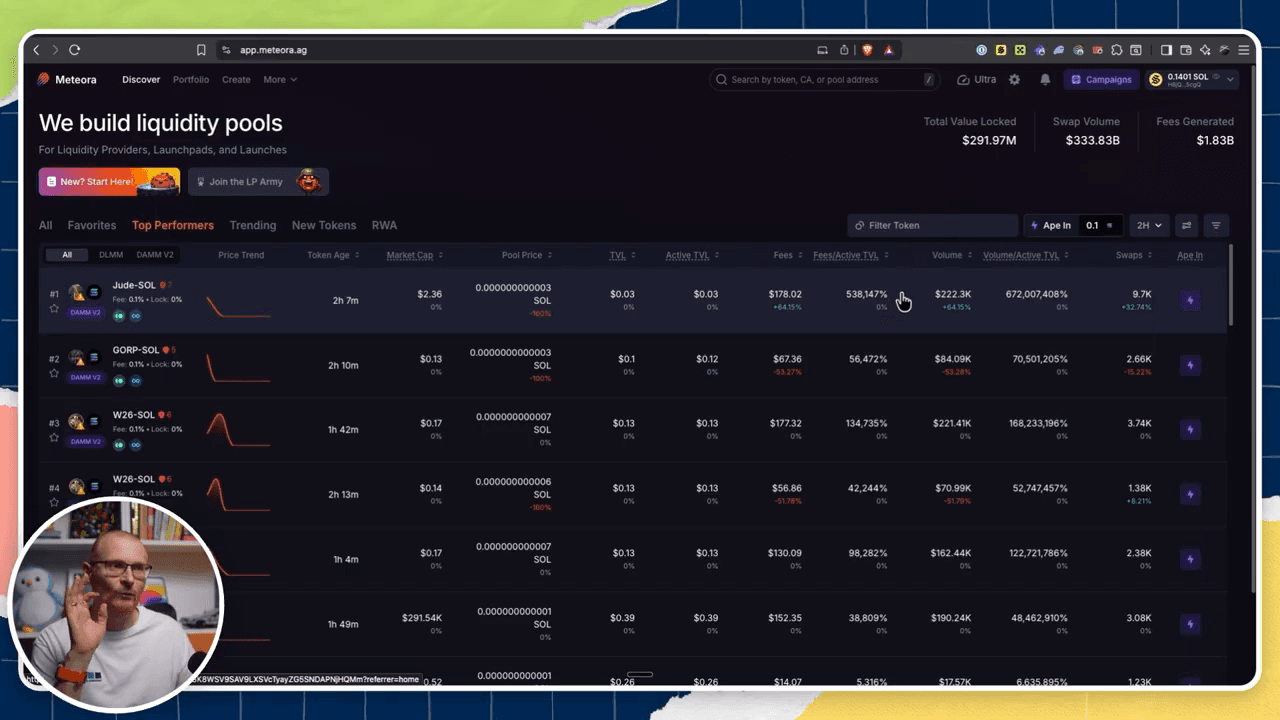
You can provide liquidity today, into the Raydium or Meteora pools, and earn swap fees. Before you do, make sure you are aware of basic LP best practices: BOT tracks a stock that can gap on Nasdaq news while the token trades 24/7/365, so the divergence can arrive as a sudden jump or drop in price.
One handy check before you trade: Jupiter shows whether you are getting a discount or paying a premium to the stock’s price. If the discount is negative, you are overpaying. If it is positive, you are paying less than the share costs on Nasdaq.
If you want to redeem the token for the actual stock, that runs through the Backpack exchange, with the eligibility rules covered below. And BOT is not alone: there are multiple tokenized stocks trading on-chain now, and the Backpack Securities versions with Sunrise liquidity are our preferred way to hold them.
The token is issuer-controlled. It is a Token-2022 with freeze, clawback, and pause authorities held by the issuer. Deposits are permissionless right now, but this is not a trust-minimized asset. Backpack can technically freeze or claw back, which is the trade for real-share backing and redemption.
#Who can actually do this
Eligibility splits in two: Backpack’s KYC brokerage flow, and the open DEX route that never touches it.
Backpack Securities’ own app is not open to US persons, and also not in the UK, UAE, or Japan, and not on Backpack EU. If you go through Backpack’s brokerage flow, you complete KYC and you get the redemption path. The structure is designed to let you redeem the token one for one for the underlying share and move it to a traditional brokerage over ACATS and DTCC rails. Backpack says that redemption and external transfer is not yet active during the public beta, so today it is a promised feature, not a live one.
The token itself is a permissionless Solana SPL. It trades on Raydium, Meteora, and through Jupiter without touching Backpack’s KYC gate, which is how a self-custody wallet ends up holding it. Judge your own eligibility before you use that path, and know what you are holding. On the DEX route you have price exposure to a backed token. But redemption to real shares, plus any future dividend or voting feature, runs through Backpack, which is geo-restricted and still in beta. Those shareholder features are not switched on for token holders yet anyway, and the fund pays no dividend to begin with.
Quick recap before the verdict:
- The token: real BOT shares held one for one by regulated broker-dealers, tradable around the clock on Raydium, Meteora, and Jupiter at about $27.43 when checked on July 20.
- The fine print: the issuer can freeze or claw back, redemption to real shares is not live yet, and the fund pays no dividend.
- LP reality: about $214,000 of observed pool liquidity and about $241,000 of 24-hour trading volume on July 20; income is swap fees only, and divergence can arrive as an overnight jump.
#Pros and cons
#The case for
- A real operator. Kang bought Figure at $2.6B, rode it to $39B, and backed Apptronik early, with his own money, before this fund existed.
- Access you cannot get otherwise. Private robotics equity in one liquid ticker, now holdable from a Solana wallet.
- Genuine backing. Real shares, held one for one by regulated broker-dealers. They exist and are held for you.
- The flywheel works for you while the premium holds and the marks keep rising. NAV is up 45 percent in a month, though the fund sets that mark itself.
- Lead-investor pipeline. The fund is leading primary rounds, so it can get into the next winner early.
- On-chain and composable. Around the clock trading, self-custody, and LP-able today.
#The case against
- You pay about 2.60x a self-marked NAV, a 160 percent premium. Most of the portfolio is priced by the fund itself, with no market check.
- The flywheel reverses if the premium compresses or the private marks get written down.
- Dilution is structural. A $2 billion equity facility behind a sub-billion market cap points one way.
- Precedent is ugly. DXYZ ran this play, spiked to a roughly 20x premium, then collapsed 93 percent in 8 weeks.
#So does it go big?
Short answer: yes, but as a small, high-variance bet you hold for years, not a position you size like a conviction buy. The upside is real. The entry price means it can round-trip you first, and the July slide below $30 was a small taste.
The case for big: if physical AI is the platform of the next decade, the winners are private right now, and BOT is the cleanest wrapper anyone has built for owning them. The on-chain version removes the last barrier, access. A credible operator, companies that are already winning, and a machine that turns the premium into NAV growth. That mix carried the best business development companies for decades.
The case against is price. Even after the July slide, roughly 2.8x a self-marked NAV is a lot of forward performance to buy up front. The flywheel runs only while the market keeps believing, and DXYZ showed how fast belief can crack.
Where we land: a long-hold bet, not a trade. If you believe in the robots and in Kang, the backed BOT token is the most direct way to hold that view on-chain. Treat any LP position as a small, fee-earning sleeve, not a yield engine. And size the whole thing like the illiquid, concentrated bet it is. The variance is the entire point.
Nothing here is financial advice. We have done the research and believe everything above was factual at the time of writing, but things change fast and we can get things wrong. Pair this piece with your own research, and a good AI researcher, before you decide whether any of it is worth a position.
For the exceptionally bullish case, and for questions, follow Duncan of Flood Capital on X. He has built a full NAV scenario model for BOT, PIPEs and share issuance included, and his stated target is $300.
Figures are as of July 20, 2026 and they expire. NAV of $10.51 and net assets of $248.9 million are the fund’s latest published unaudited mark, dated June 30, 2026. At 11:40 AM ET on July 20, BOT last traded at $27.32, equal to 2.60x NAV or a 160 percent premium. The $19.20 all-time low, set May 13, 2026, remained intact. On July 20, the Backpack Securities token was around $27.43 on its largest pool, with about $214,000 of observed liquidity across Solana pools and about $241,000 of 24-hour trading volume. On-chain price, pool depth, and token supply move constantly. Verify the Backpack mint address before you buy, confirm current pool liquidity on DexScreener, and check your own jurisdiction. This is research, not financial advice.
Sources
Fund, NAV and filings
- RoboStrategy portfolio (latest NAV and holdings, Jun 30 2026)
- RoboStrategy: NAV update to $10.51 per share, Jun 30 2026
- Investing.com: 17.8% NAV increase, $7.6M placement
- StockTitan: NAV update and per-name breakdown, Jun 22 2026
- SEC EDGAR filings, CIK 0002081119
Stock price and short interest
- Nasdaq: BOT market data
- Yahoo Finance: BOT
- StockTitan: BOT overview
- GlobeNewswire: Nasdaq listing, May 11 2026
- Ticker Report: BOT short interest up 166% (Jun 15 settlement)
- MarketBeat: BOT short interest tracker
On-chain: Backpack, Sunrise, pools
- CoinGecko: BOT (Backpack Securities)
- DexScreener: BOT pools
- Sunrise, Solana’s asset gateway
- Backpack: what are tokenized stocks
- Backpack Securities: real ownership and legal framework
The operators
- GlobeNewswire: RoboStrategy announces Andrew Kang as CEO
- Yahoo Finance: RoboStrategy CEO explains the shift
- PANews: Andrew Kang and RoboStrategy
- Arkham: Andrew Kang trader profile
- Mechanism Capital: our investment in Apptronik
- Bitget News: Kang’s own account of the $19M Figure position
Portfolio companies and market size
- Figure AI Series C ($39B)
- TechCrunch: Figure reaches $39B
- CNBC: Apptronik raises $520M
- PRNewswire: Standard Bots $200M Series C, led by RoboStrategy
- Goldman Sachs: humanoid market to $38B by 2035
- Morgan Stanley: humanoid economy to $5T by 2050
Comparables and precedent
Independent research, without the daily noise.
New work arrives when there is something useful to explain.